




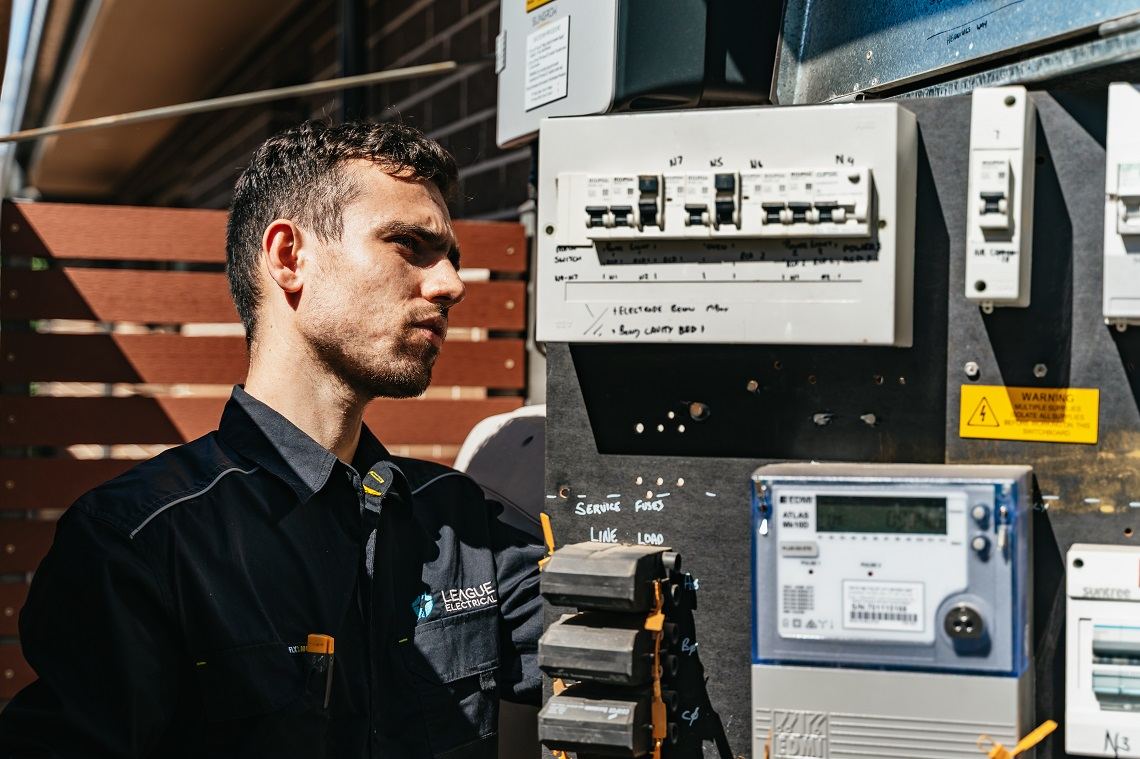
If your switchboard has ceramic fuses, no safety switches installed, or it keeps tripping, it needs upgrading, fast. The same applies if it feels warm, smells off, or sits on an asbestos backing board.
Most Sydney homes built before the 2000s have switchboards that were never designed for modern electrical loads. And, unfortunately, your switchboard is the most neglected part of your home.
The NSW Government reports that around 40% of house fires in NSW start with electrical faults or appliances. Up to 1,800 of those each year could have been prevented with a wiring check and safety switches.
Think closely, and you’d be shocked to understand how important its maintenance is, especially in terms of your family’s safety. One short circuit at an unanticipated time and your entire house and family are at high risk.
We have some good news for you. You don’t need to be a licensed electrician in Sydney to spot the trouble. At League Electrical, we recommend getting your home’s electrical system checked every 3 to 5 years or yearly for more safety.
Outdated fuses, frequent tripping, missing RCD protection or heat damage. A lot can go wrong if it's not dealt with in time. Here are the 5 signs you need to be aware of.
62% of Sydney homes still have ceramic fuses or rewireable fuse carriers, and this is the clearest sign of all.
Open your meter box and look for white porcelain holders with thin wire running through them. If you have something that looks similar, your switchboard is likely forty years old or more.
Ceramic fuses protect against overload, but they don’t protect against electric shock as modern safety switches do.
The second problem is that if one blows, someone has to rewrite it by hand. That’s where the wrong gauge wire gets used, and that creates a real fire risk nobody can see until it happens.
If you’re still rewiring a fuse when the power drops out, call 1800 734 903 any hour, and our licensed electricians will help you upgrade your switchboard.
Tripping once in a while shows your safety system is active and working well. Fire and Rescue NSW attends roughly 4,500 residential fires a year. Electrical faults and appliances cause almost 40% of them. Overloaded circuits sit behind a good share of that.
But frequent tripping is a warning sign. It can mean one of the three things mentioned below:
Think about what your home is running right now. This could include ducted air conditioning, induction cooktops, EV chargers, and a house full of devices. Honestly, older boards were never designed for this kind of crazy load. That’s why the circuit trips the moment the burden becomes too much for it.
One thing to avoid completely is never fitting a higher-rated fuse to stop the tripping; that removes the protection instead of fixing the cause.
Safety switches and circuit breakers have different functions.
A safety switch, also called an RCD, detects current leaking where it shouldn’t go (that includes a person). It then cuts the power in a fraction of a second.
Australian wiring rules require RCD protection on final subcircuits. When a switchboard gets replaced, the new board must meet that standard.
Here’s a quick check: look for small test buttons on your board. If there are no test buttons visible, usually it means there is no safety protection at all.
Switchboards that were mounted before the mid-1980s were often mounted on asbestos sheeting.
Before we say anything, let’s be clear about the risk, because the topic attracts a lot of scaremongering. Undisturbed asbestos in good condition is not dangerous. Leave it alone, and it is absolutely harmless. But the problem arises when the board gets replaced, and the backing has to come off first. Only a licensed asbestos removalist can do that work, and that affects the timeline and cost of your upgrade.
Book an inspection, and we’ll recommend the best solution and switchboard upgrade cost in Sydney too.
This is an urgent problem, and if you’ve noticed anything, immediately call our licensed electricians in Sydney at 1800 734 903.
A healthy switchboard is cool to touch, silent, and unmarked, but if you notice anything else, it needs immediate attention.
Watch for these warning signs:
If you’ve noticed any of these signs, turn the power off at the main switch and call an expert electrician in Sydney. Don’t wait to see whether it settles on its own.
League Electrical runs 24/7 emergency electrician Sydney callout for exactly this type of problem.
There are plenty of reasons you might want to upgrade your switchboard to avoid overloading it. For instance:
If you are adding significant load to an old board, upgrade first. It costs less than fixing what an overloaded board does.
When you call League Electrical for a switchboard upgrade, your power gets safely isolated at the mains. The old board, fuses and enclosure come out. Then our expert, licensed removalist removes the asbestos backing, and a new enclosure goes in, fitted with modern circuit breakers, safety switches, and a main switch.
Every circuit gets mapped, connected, and clearly labelled, and the whole board gets tested and then certified as compliant.
Give it a quick visual check once a month and look for damage, corrosion, discolouration, or anything that’s changed since last time.
Then book a professional inspection, ideally once a year. An electrician spots the developing faults you can’t see from the outside.
If you spotted even one of these five signs, get it checked properly.
Our licensed Level 2 electricians handle switchboard upgrades and repairs across Sydney, on every type of board. We’ll inspect what you have and give a clear and concise quote before stepping foot in your home.
Call League Electrical on 1800 734 903. We’re available 24/7 for electrical emergency in Sydney.
May His light shine through our service.

Contact Us:
Opening Hours:
(Emergency work 24 hours x 7 days a week)
Quick Links
Electrical Services
Other Services
Copyright © 2026 League Electrical | Terms of Use
Website & SEO by Digital Marketing Agency Digital Impact Gurus
